as
VDDS - Virtio Ring Buffer based DDS
VDDS is a lightweight zero-copy publish/subscribe data-sharing service for inter-process communication (IPC). It is inspired by iceoryx but deliberately kept small:
- no central daemon (iceoryx needs the RouDi daemon) - the publisher creates the shared memory objects and the subscribers attach to them;
- no data copy and no socket transport - the payload lives in shared memory and only 4-byte descriptor indices are exchanged through rings;
- single publisher, multiple consumers (SPMC), with a per-descriptor reference counter so a data buffer is recycled only after every online subscriber has consumed it;
- about 1000 lines of C++11 in namespace
as::vdds, easy to study and port.
The design borrows the virtio split-vring idea: an AVAIL ring hands free buffers from the writer side to the producer, and one USED ring per reader delivers filled buffers to the consumers. The code lives in infras/libraries/dds/vdds/.
1. Architecture
One topic is one connection. A topic consists of:
- one control shared-memory object holding META, the descriptor table, the
AVAIL ring and up to
VRING_MAX_READERS(8 by default) USED rings; numDescdata shared-memory objects ofmsgSizebytes each, addressed by the descriptors. On Linux, when/dev/dma_heap/systemexists the build definesUSE_DMA_BUFand DMA-BUF heaps are used (the descriptor stores the DMA-BUF handle); plain POSIXshm_openis used otherwise;- one named semaphore for the AVAIL ring (initial count
numDesc) and one named semaphore per reader USED ring (initial count 0).
The topic name is converted to an object name by prefixing as and replacing
/ with _; for example topic /hello_wrold/xx maps to shared memory and
semaphore name as_hello_wrold_xx.
All regions are 64-byte aligned (VRING_ALIGNMENT). Let N = numDesc - 1 and
K = VRING_MAX_READERS - 1; the control region layout is:
flowchart TD
    subgraph CTRL["control shared memory: as_hello_wrold_xx"]
        META["META: msgSize, numDesc"]
        DESC["DESC[0..N]: timestamp, handle, len, spin, ref"]
        AVAIL["AVAIL: lastIdx, spin, idx, ring[] of free DESC indices"]
        subgraph USEDS["USED[0..K]: one slot claimed per online reader"]
            U0["USED[0]: state, heart, lastHeart, lastIdx, idx, ring[]"]
            U1["USED[1]: state, heart, lastHeart, lastIdx, idx, ring[]"]
            UK["USED[K]: state, heart, lastHeart, lastIdx, idx, ring[]"]
        end
        META --> DESC --> AVAIL --> U0 --> U1 --> UK
    end
    D0["data shm as_hello_wrold_xx_0_msgSize"]
    D1["data shm as_hello_wrold_xx_1_msgSize"]
    DN["data shm as_hello_wrold_xx_N_msgSize"]
    DESC -. handle or index .-> D0
    DESC -. handle or index .-> D1
    DESC -. handle or index .-> DN
The key structures (see include/vring/base.hpp and
include/vring/spmc/base.hpp) are:
VRing_MetaType { msgSize, numDesc }- published geometry, checked by every reader when it attaches;VRing_DescType { timestamp, handle, len, spin, ref }- one data buffer.timestampis the publish time in microseconds,refis the number of readers that still hold the buffer,spinprotects the compound ref/ring operations;VRing_AvailType { lastIdx, spin, idx, ring[] }- free descriptor indices. The writer consumes atlastIdx, buffers are returned atidx;VRing_UsedType { state, heart, lastHeart, lastIdx, idx, ring[] }with ring elements{ id, len }- one ring per reader.stateis atomic and movesFREE(0) -> INIT(1) -> READY(2), andREADY -> KILLED(3) -> FREEwhen the writer reaps a dead reader.
Synchronization combines three mechanisms:
- named semaphores block a side until the other side makes progress;
- atomic operations on
DESC.refandUSED.state/heartcoordinate the cross-process reference counting and reader registration; - spinlocks (rigtorp MCS-style ticket exchange,
implemented with
__atomic_exchange_n) protect short compound sections:AVAIL.spinfor the free ring andDESC[i].spinfor one descriptor. A lock attempt that spins longer thanVRING_SPIN_MAX_COUNTERfails withEDEADLKinstead of spinning forever.
2. Publish / subscribe flow
With two readers online, one sample travels like this:
sequenceDiagram
    participant W as Writer / Publisher
    participant A as AVAIL ring
    participant R0 as Reader 0 / USED[0]
    participant R1 as Reader 1 / USED[1]
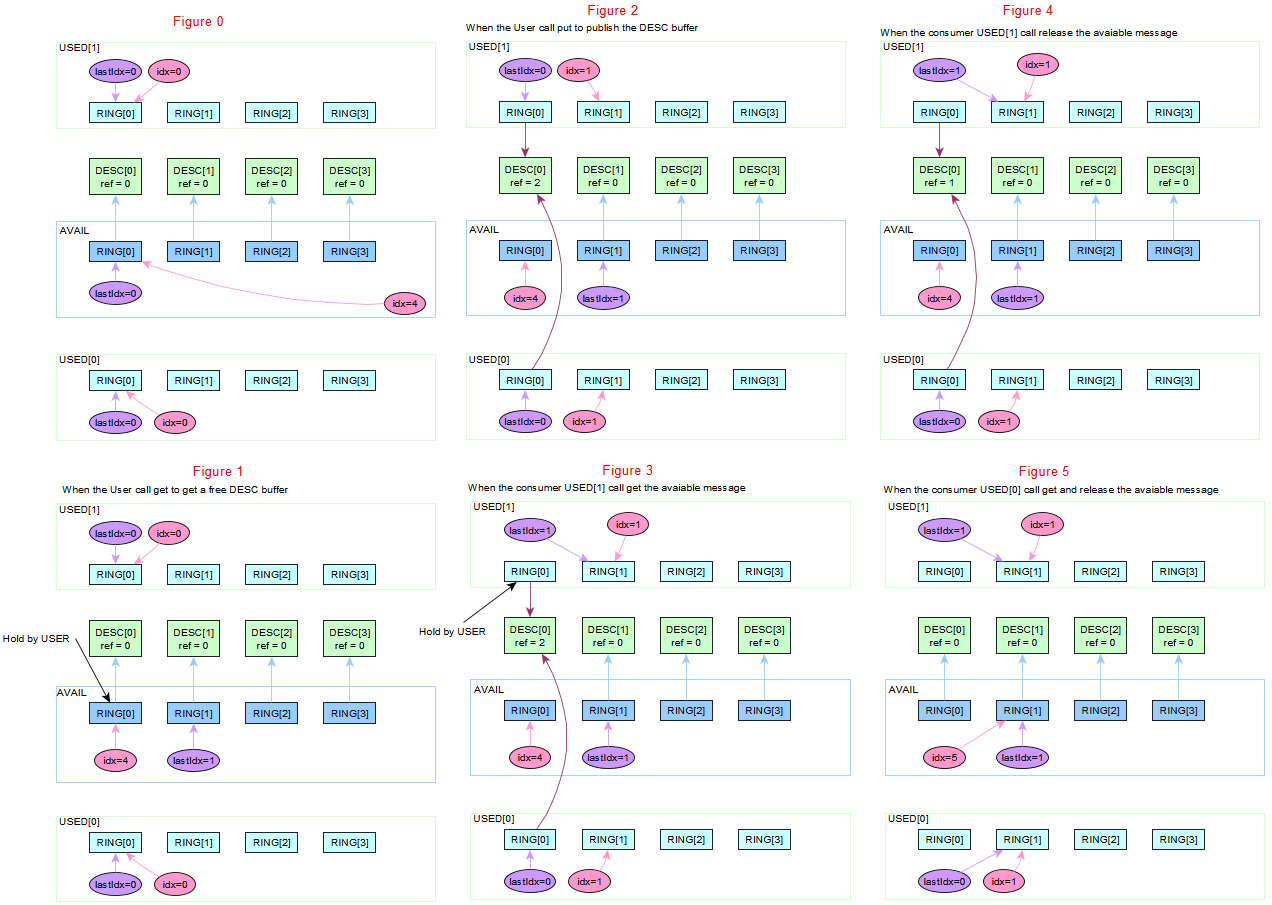
    W->>A: get: wait sem_avail, take DESC[0] at lastIdx, check ref == 0, lastIdx++
    Note over W: fill the data buffer in place (zero copy)
    W->>R0: put: ring[idx] = {0, len}, ref 0 -> 1, USED[0].idx++
    W->>R1: put: ring[idx] = {0, len}, ref 1 -> 2, USED[1].idx++
    W-->>R1: post sem_used1
    W-->>R0: post sem_used0
    R1->>R1: get: wait sem_used1, take elem at lastIdx, lastIdx++
    Note over R1: process the shared data buffer
    R1->>A: put: ref 2 -> 1, still held, nothing returned
    R0->>R0: get: wait sem_used0, take elem at lastIdx, lastIdx++
    Note over R0: process the shared data buffer
    R0->>A: put: ref 1 -> 0, return DESC[0] at idx, idx++
    R0-->>W: post sem_avail, DESC[0] is reusable
Step by step:
- Writer init (
Writer::init) creates the control object withO_CREAT | O_EXCL, creates thenumDescdata buffers, fills the AVAIL ring (ring[i] = i,idx = numDesc), creates the semaphores and starts a monitor thread. A second writer cannot be created on the same topic. - Reader init (
Reader::init) opens the already existing objects. It atomically claims the first FREE USED slot (FREE -> INIT -> READY) and starts a heartbeat thread. If the publisher is not online yetshm_openfails andEEXISTis returned (the sample retriesinit()once per second); if all 8 USED slots are taken,ENOSPCis returned. - load() / get(): the writer waits on the AVAIL semaphore, takes
ring[lastIdx], verifiesref == 0, advanceslastIdxand hands the application the direct pointer into the data buffer. Return values are 0,ETIMEDOUT(no post within the timeout) orENODATA(all buffers are currently lent out). - publish() / put(): under
DESC[idx].spin, the writer appends{id, len}to every READY USED ring, atomically incrementsrefonce per reader and advances that ring’sidx, then posts the reader semaphores. If no reader is online, the descriptor is dropped straight back into the AVAIL ring andENOLINKis returned. - receive() / get(): a reader waits on its own USED semaphore, verifies
its slot is still READY, takes the element at
lastIdx, advanceslastIdxand returns the direct shared-memory pointer (0,ETIMEDOUTorENOMSG). - release() / put(): under
DESC[idx].spin, the reader atomically decrementsref. Whileref > 0other readers still hold the buffer; the last reader seesref == 0, takesAVAIL.spin, appends the index atidx, advancesidxand posts the AVAIL semaphore so the writer can reuse the buffer.
The single-writer discipline makes most indexes lock-free; spinlocks are only needed where a compound update or a multi-reader race exists:
| Field | Updated by | Rule |
|---|---|---|
| AVAIL.lastIdx | Writer get() only |
single writer, no race |
| AVAIL.idx | Writer drop() and the last Reader put() |
several readers may race, protected by AVAIL.spin |
| USED[i].idx | Writer put() only |
single writer, no USED lock needed |
| USED[i].lastIdx | owning Reader get() only |
one owner per claimed slot |
| DESC.ref | Writer put() inc, Reader put() dec |
atomic RMW; compound “dec then recycle” guarded by DESC.spin |
| USED.state, USED.heart | reader and writer cross-update | plain atomics (__atomic_*) |
Fault handling
Real processes crash and stall, so the writer runs a monitor thread every
500 ms (threadMain):
- reader heartbeat: every reader increments its
heartcounter every 100 ms. If the counter stops moving, the writer marks the slot KILLED, drains every descriptor still pending in that USED ring throughreleaseDesc()(so references are released and buffers are recycled), then marks the slot FREE again for a new reader to claim; - descriptor lifetime: if a descriptor stays referenced for longer than
VRING_DESC_TIMEOUT(2,000,000 us, 2 seconds), it is force-recycled. This means an application held a sample without releasing it - the code comments call this out as a fatal application bug, the recycle only keeps the system alive; - clean reader exit: the reader destructor first releases every unconsumed buffer in its own USED ring and then clears its slot state to FREE.
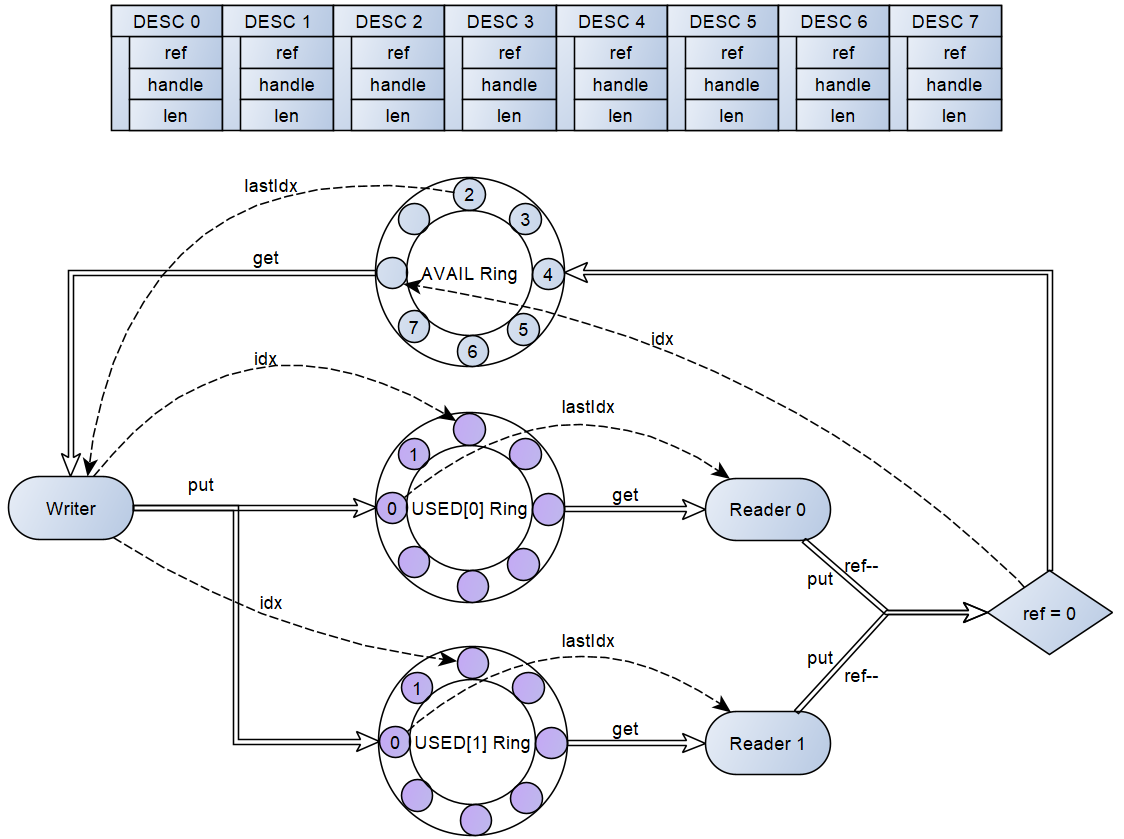
The figure above shows the rings and index movement around a descriptor; the figure below shows the end-to-end zero-copy data path through the shared memory regions.
3. Application API
Include the aggregate header and use namespace as::vdds:
#include "vdds.hpp"
using namespace as::vdds;

typedef struct {
  char string[128];
} HelloWorld_t;
Publisher side (include/publisher.hpp):
Publisher<HelloWorld_t> pub("/hello_wrold/xx");           /* queue depth 8 by default */
/* Publisher<HelloWorld_t> pub("/hello_wrold/xx", PublisherOptions(16)); */
int r = pub.init();

HelloWorld_t *sample = nullptr;
r = pub.load(sample);                 /* 0 / ETIMEDOUT / ENODATA; get a free buffer */
if (0 == r) {
  int len = snprintf(sample->string, sizeof(sample->string), "hello world");
  r = pub.publish(sample, len);       /* publish(sample) publishes sizeof(T) bytes */
}
uint32_t i = pub.idx(sample);         /* debug: descriptor index held by a sample */
Publisher<T, VRingWriter> defaults its second template parameter to
vring::spmc::Writer; vring::spsc::Writer can be selected for a
single-reader topic. The writer message size is sizeof(T) and the queue
depth (descriptor count) comes from PublisherOptions::queueDepth.
Subscriber side (include/subscriber.hpp):
Subscriber<HelloWorld_t> sub("/hello_wrold/xx");
int r = sub.init();                    /* retry while EEXIST: publisher not online yet */

size_t size = 0;
HelloWorld_t *sample = nullptr;
r = sub.receive(sample, size);        /* 0 / ETIMEDOUT / ENOMSG; zero-copy pointer */
if (0 == r) {
  /* process sample->string ... */
  r = sub.release(sample);            /* MUST release once per received sample */
}
Subscriber<T, VRingReader> likewise defaults to vring::spmc::Reader;
init() returns EEXIST while the publisher shared memory does not exist and
ENOSPC when all reader slots are occupied.
4. Build and run
The applications are registered in infras/libraries/dds/vdds/SConscript:
| App | Source | Ring variant |
|---|---|---|
| VDDSHwPub | examples/hello_world_publisher.cpp | SPMC writer |
| VDDSHwSub | examples/hello_world_subscriber.cpp | SPMC reader |
| VDDSHwSPub | examples/hello_world_publisher.cpp | SPSC writer (-DVRING_WRITER=vring::spsc::Writer) |
| VDDSHwSSub | examples/hello_world_subscriber.cpp | SPSC reader (-DVRING_READER=vring::spsc::Reader) |
| VDDSHwPS | examples/hello_world_ps.cpp | one process: 1 publisher thread + N subscriber threads |
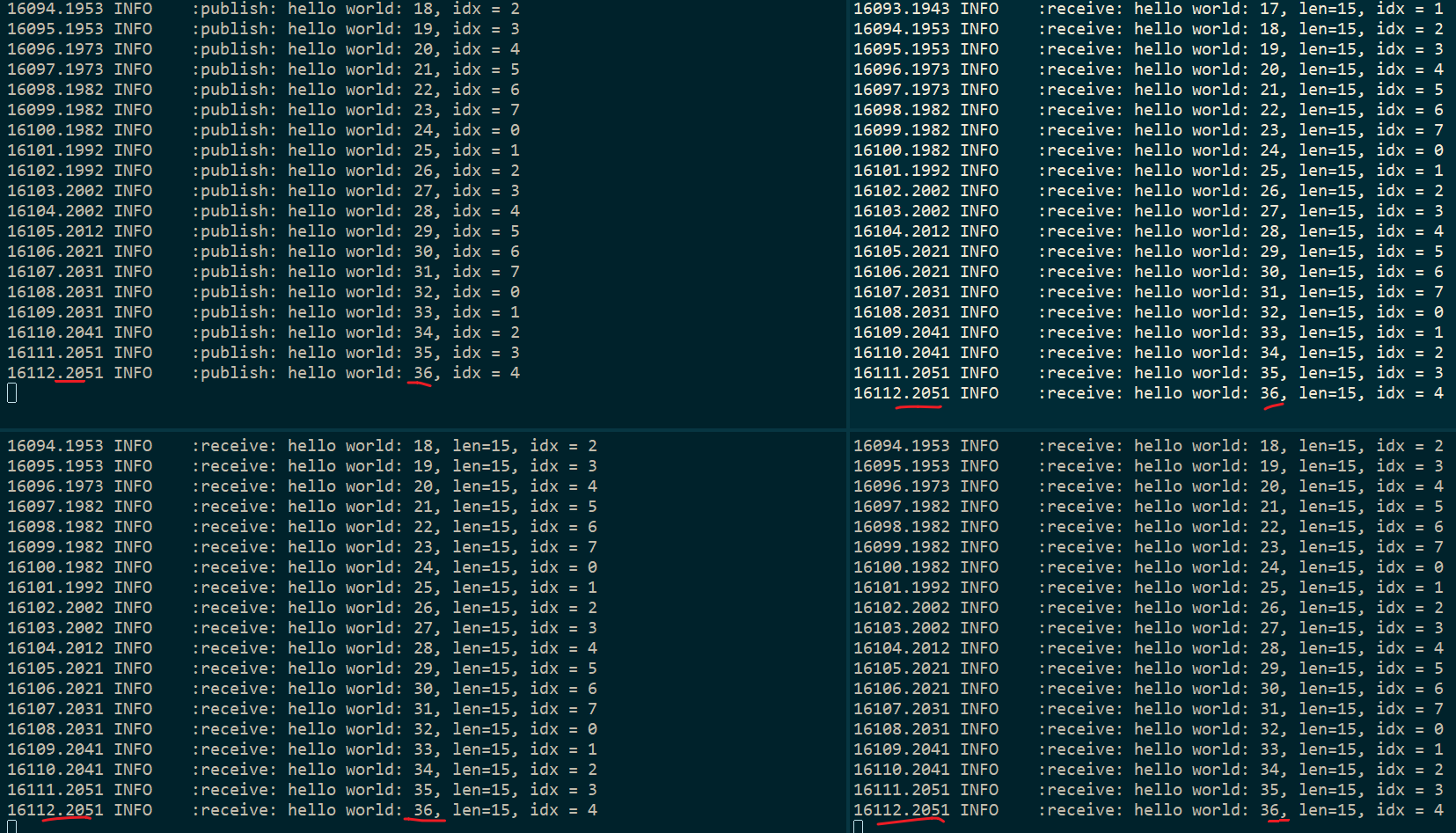
Multi-process demo, one publisher and three subscribers:
scons --app=VDDSHwPub
scons --app=VDDSHwSub

# terminal 1
build/posix/GCC/VDDSHwPub/VDDSHwPub -p 1000

# terminals 2, 3, 4
build/posix/GCC/VDDSHwSub/VDDSHwSub
build/posix/GCC/VDDSHwSub/VDDSHwSub
build/posix/GCC/VDDSHwSub/VDDSHwSub
Single-process demo (publisher and subscribers are threads, handy for a quick
smoke test); -n sets the subscriber count and -p the publish period in
milliseconds:
scons --app=VDDSHwPS
build/posix/GCC/VDDSHwPS/VDDSHwPS -n 3 -p 100
Linux and WSL are the primary run environments (the screenshot below is taken
in WSL). POSIX shared memory and named semaphores are used directly, and
DMA-BUF is enabled automatically when /dev/dma_heap/system is present. A
native Windows port of the platform layer (shm_open/mmap and semaphore
shims) exists under src/platform/win/.
5. Source layout
infras/libraries/dds/vdds/
  include/
    vdds.hpp               aggregate header (publisher + subscriber)
    publisher.hpp          Publisher<T> template
    subscriber.hpp         Subscriber<T> template
    shared_memory.hpp      POSIX shm wrapper
    named_semaphore.hpp    named semaphore wrapper
    dma_memory.hpp         data buffer / DMA-BUF wrapper
    vring/base.hpp         META / USED types, ring size macros, spinlock
    vring/spmc/            single publisher, multiple consumers ring
    vring/spsc/            single publisher, single consumer ring
  src/                     matching implementations
    platform/linux/        DMA-BUF backend
    platform/win/          shm and semaphore shims for native Windows
  examples/                hello_world_ps / hello_world_publisher / _subscriber