as
AUTOSAR SOME/IP and SOME/IP-SD
SOME/IP (Scalable service-Oriented MiddlewarE over IP) is the AUTOSAR standard for service-oriented communication over Ethernet/IP: a server offers services (methods, events and fields), a client discovers them dynamically and invokes them, without any static binding at build time. SOME/IP-SD (Service Discovery) is the control protocol that lets servers and clients find each other at runtime.
This article introduces the AS SOME/IP stack, its JSON configuration, and the host-side example applications that can be built and run without any ECU hardware.
Table of Contents
- Protocol Basics
- Stack Architecture
- Configuration (Network.json)
- Host Examples
- NetApp / NetAppT (Integrated Stack)
- Interoperability with vsomeip
- Troubleshooting
1. Protocol Basics
A SOME/IP message consists of a 16-byte header followed by the serialized payload:
packet-beta
title SOME/IP Message Header
0-15: "Message ID: Service ID"
16-31: "Message ID: Method/Event ID"
32-63: "Length"
64-79: "Request ID: Client ID"
80-95: "Request ID: Session ID"
96-103: "Protocol Version"
104-111: "Interface Version"
112-119: "Message Type"
120-127: "Return Code"
128-159: "Payload ..."
The message types implemented by this stack (see SomeIp.c):
| Type | Value | Direction |
|---|---|---|
| REQUEST | 0x00 | client -> server, response expected |
| REQUEST_NO_RETURN | 0x01 | client -> server, fire-and-forget |
| NOTIFICATION | 0x02 | server -> client, event |
| RESPONSE | 0x80 | server -> client |
| ERROR | 0x81 | server -> client |
| TP flag | 0x20 | OR-ed into the type for SOME/IP-TP segmented messages |
A plain UDP datagram carries a payload up to 1396 bytes; larger payloads use SOME/IP-TP (the segmented transport, max 1392 bytes per segment, offset field in the TP header). TCP is used for reliable methods.
SOME/IP-TP Request/Response Flow
The sequence diagram below shows the complete UDP request/response TP flow, including the asynchronous server pattern (SOMEIP_E_PENDING):
sequenceDiagram
    participant ClientApp as Client Application
    participant ClientSOMEIP as Client SOME/IP Stack
    participant UDP as UDP Network
    participant ServerSOMEIP as Server SOME/IP Stack
    participant ServerApp as Server Application
    participant Main as SomeIp_MainFunction

    Note over ClientApp,Main: client sends the request
    ClientApp->>ClientSOMEIP: SomeIp_Request() - send request
    ClientSOMEIP->>ClientSOMEIP: SomeIp_RequestOrFire() - process request

    alt Request needs TP (large message)
        ClientSOMEIP->>ClientSOMEIP: Create SomeIp_TxTpMsgType - track TX status (offset, length, timer, sessionId)
        ClientSOMEIP->>ClientSOMEIP: SomeIp_SendNextTxTpMsg() - prepare first TP segment
        ClientSOMEIP->>ClientApp: onTpCopyTxData() - get segment data from application
        ClientSOMEIP->>UDP: Send SOME/IP UDP TP Request Segment 1
        UDP->>ServerSOMEIP: SomeIp_RxIndication() - receive request(s)
        ServerSOMEIP->>ServerSOMEIP: SomeIp_ProcessRxTpMsg() - process request Segment 1
        ServerSOMEIP->>ServerSOMEIP: Create SomeIp_RxTpMsgType - track RX status (offset, timer, clientId, sessionId)
        ServerSOMEIP->>ServerApp: onTpCopyRxData() - copy request Segment 1
        loop Until all request segments sent
            Main->>ClientSOMEIP: SomeIp_MainFunction() - next iteration
            ClientSOMEIP->>ClientSOMEIP: SomeIp_MainClientTxTpMsg() - process pending TxTpMsg
            ClientSOMEIP->>ClientSOMEIP: SomeIp_SendNextTxTpMsg() - prepare next segment
            ClientSOMEIP->>ClientApp: onTpCopyTxData() - get next segment data
            ClientSOMEIP->>UDP: Send SOME/IP UDP TP Request Segment N
            UDP->>ServerSOMEIP: SomeIp_RxIndication() - receive request(s)
            ServerSOMEIP->>ServerSOMEIP: SomeIp_ProcessRxTpMsg() - update RX status
            ServerSOMEIP->>ServerApp: onTpCopyRxData() - copy request Segment N
        end
        ServerSOMEIP->>ServerSOMEIP: All segments received, assemble complete message
        ServerSOMEIP->>ServerApp: onRequest() - forward complete request
    else Request is small (single segment)
        ClientSOMEIP->>UDP: Send SOME/IP UDP Request (single segment)
        UDP->>ServerSOMEIP: SomeIp_RxIndication() - receive request(s)
        ServerSOMEIP->>ServerApp: onRequest() - forward complete request
    end

    Note over ServerApp,Main: server processes the request asynchronously
    ServerApp-->>ServerSOMEIP: Return SOMEIP_E_PENDING - processing deferred
    ServerSOMEIP->>ServerSOMEIP: Store AsyncReqMsg - cache request info
    Main->>ServerSOMEIP: SomeIp_MainFunction() - periodic main loop
    ServerSOMEIP->>ServerSOMEIP: SomeIp_MainServer() / SomeIp_MainServerAsyncRequest()
    ServerSOMEIP->>ServerApp: onAsyncRequest() - get response from application
    ServerApp-->>ServerSOMEIP: Return E_OK with response data
    ServerSOMEIP->>ServerSOMEIP: SomeIp_ReplyRequest() - prepare response

    alt Response needs TP (large message)
        ServerSOMEIP->>ServerSOMEIP: Create SomeIp_TxTpMsgType - track TP reply status
        ServerSOMEIP->>ServerSOMEIP: SomeIp_SendNextTxTpMsg() - prepare first TP segment
        ServerSOMEIP->>ServerApp: onTpCopyTxData() - get segment data
        ServerSOMEIP->>UDP: Send SOME/IP UDP TP Response Segment 1
        UDP->>ClientSOMEIP: SomeIp_RxIndication() - receive response
        ClientSOMEIP->>ClientSOMEIP: SomeIp_ProcessRxTpMsg() - process response Segment 1
        ClientSOMEIP->>ClientSOMEIP: Create SomeIp_RxTpMsgType - track RX status
        ClientSOMEIP->>ClientApp: onTpCopyRxData() - copy response Segment 1
        loop Until all response segments sent
            Main->>ServerSOMEIP: SomeIp_MainFunction() - next iteration
            ServerSOMEIP->>ServerSOMEIP: SomeIp_MainServerTxTpMsg() - process pending TxTpMsg
            ServerSOMEIP->>ServerSOMEIP: SomeIp_SendNextTxTpMsg() - prepare next segment
            ServerSOMEIP->>ServerApp: onTpCopyTxData() - get next segment data
            ServerSOMEIP->>UDP: Send SOME/IP UDP TP Response Segment N
            ClientSOMEIP->>ClientSOMEIP: SomeIp_ProcessRxTpMsg() - update RX status
            ClientSOMEIP->>ClientApp: onTpCopyRxData() - copy response Segment N
        end
        ClientSOMEIP->>ClientSOMEIP: All segments received, assemble complete message
        ClientSOMEIP->>ClientApp: onResponse() - forward complete response
    else Response is small (single segment)
        ServerSOMEIP->>UDP: Send SOME/IP UDP Response (single segment)
        UDP->>ClientSOMEIP: SomeIp_RxIndication() - receive response
        ClientSOMEIP->>ClientApp: onResponse() - forward complete response
    end
Notes:
- Timing of
SomeIp_RxIndication(): on the server side it is called shortly after the client sends the request segment(s); on the client side it is called shortly after the server sends the response segment(s). - TP message handling: the TX side tracks segmented transfer state in
SomeIp_TxTpMsgType(offset, timer, sessionId), the RX side tracks and assembles inSomeIp_RxTpMsgType;SomeIp_MainFunctionadvances pending TX/RX TP messages periodically, so the main function must be scheduled cyclically. - Async request processing: when the server application returns
SOMEIP_E_PENDING, the request is cached as anAsyncReqMsg; the main function later obtains the finished response via theonAsyncRequest()callback. - Callback roles:
onTpCopyTxData()fetches segment data from the application for transmission;onTpCopyRxData()delivers received segment data;onRequest()delivers a complete request;onAsyncRequest()fetches the response for a pending request;onResponse()delivers a complete response to the application.
SOME/IP-SD itself is a SOME/IP message (service ID 0xFFFF, method ID 0x8100, UDP) exchanged over a configurable multicast group. Its entries (see Sd.c) are:
| Entry | Value | Purpose |
|---|---|---|
| FindService | 0x00 | client searches for a service instance |
| OfferService | 0x01 | server announces a service instance (cyclic / on demand) |
| SubscribeEventgroup | 0x06 | client subscribes to an event group |
| SubscribeEventgroupAck/Nack | 0x07 | server accepts/rejects the subscription |
(plus the matching StopOfferService / StopSubscribeEventgroup entries). Every entry carries a TTL; an entity disappears when its offer/subscription expires or is sent with TTL = 0.
2. Stack Architecture
The implementation follows the AUTOSAR CP 4.4 module decomposition, but SomeIp and Sd are not strict layers: they are peer modules sitting side by side on top of SoAd, cooperating through a set of horizontal APIs:
flowchart TD
    APP["Application / generated Skeleton & Proxy (C API or ARA-style C++)"]
    XF["SomeIpXf (serialization / deserialization of method arguments)"]
    SIP["SomeIp (method calls, event notifications, SOME/IP-TP segmentation)"]
    SD["Sd (discovery FSM: offer / find / subscribe,<br/>keeps the provider address and subscriber tables)"]
    SOAD["SoAd (socket connectors: TCP/UDP sockets and PDU routing)"]
    TCPIP["TcpIp (LWIP on targets; native host sockets with the OSAL port)"]

    APP -->|"SomeIp_Request, etc."| SIP
    APP -->|"Sd_*SetState: offer / find / subscribe"| SD
    APP --> XF
    XF -.->|"serialized payload"| SIP

    SIP -->|"Sd_GetProviderAddr(): server address lookup<br/>Sd_GetSubscribers(): event subscriber lookup<br/>Sd_NotifyServiceOffline() / Sd_RemoveSubscriber()"| SD
    SD -->|"SomeIp_ResolveSubscriber():<br/>match a new subscriber to its TCP connection and assign the event TxPdu"| SIP

    SIP -->|"service messages TX/RX (SoAd_IfTransmit / RxIndication)"| SOAD
    SD -->|"SD messages (0xFFFF:0x8100) on its own socket TX/RX path"| SOAD
    SOAD --> TCPIP
The interactions shown above are taken from the code:
- SomeIp -> Sd: before a client sends a request, it calls
Sd_GetProviderAddr()to obtain the server address discovered by Sd (and opens the TCP connection accordingly); before a server sends an event notification, it callsSd_GetSubscribers()to get the subscriber list maintained by Sd; on connection drop or service shutdown it callsSd_RemoveSubscriber()/Sd_NotifyServiceOffline(). - Sd -> SomeIp: when the server-side Sd receives a SubscribeEventgroup entry, it calls
SomeIp_ResolveSubscriber(), and SomeIp matches the subscriber against the established TCP connections by remote address and assigns the event TxPdu (for a UDP service the unicast TxPdu is used directly; once the number of subscribers reaches MulticastThreshold, Sd switches to the multicast TxPdu and opens the multicast socket itself). - Both share SoAd but use independent paths: SD messages (Service ID 0xFFFF, Method ID 0x8100) are sent/received by Sd over its own socket connectors, while regular SOME/IP traffic uses SomeIp’s connections; on the receive path SoAd routes the PDU to either
Sd_RxIndicationorSomeIp_RxIndicationaccording to its PDU/connector.
Relevant modules under infras/communication: SomeIp, SomeIpXf, Sd, SoAd, plus the optional E2E end-to-end protection module (profiles P04/P05/P07/P11/…).
Key public APIs:
- SomeIp:
SomeIp_Request,SomeIp_RxIndication,SomeIp_SoAdTpStartOfReception,SomeIp_MainFunction(SomeIp.h); - Sd:
Sd_ServerServiceSetState(handle, SD_SERVER_SERVICE_AVAILABLE/DOWN),Sd_ClientServiceSetState(handle, SD_CLIENT_SERVICE_REQUESTED/RELEASED),Sd_ConsumedEventGroupSetState,Sd_MainFunction(Sd.h).
Application code normally never calls these directly: the code generator emits a Skeleton (server-side) and a Proxy (client-side) for every service in the configuration. The generated C API looks like:
/* server skeleton */
Std_ReturnType Math_OfferService(void);
Std_ReturnType Math_StopOfferService(void);
Std_ReturnType Math_add(const add_args_Type *args, Result_Type *ret);  /* user implements */

/* client proxy */
Std_ReturnType Math_add_Call(const add_args_Type *args);               /* asynchronous */
void Math_add_OnResponse(Result_Type *ret);                            /* user implements */
A C++/ARA-flavored variant (MathSkeleton / MathProxy with ara::core::Result, futures and callbacks) is generated as well, and a vsomeip backend can be selected for cross-stack interoperability (see section 6).
3. Configuration (Network.json)
All networking modules are configured from a single Network.json (class Net). The request/response example below is the server side of the TCP “add” example (add/config/server/Network.json):
{
  "class": "Net",
  "Modules": [
    {
      "name": "SomeIp",
      "class": "SomeIp",
      "SD": { "hostname": "ssas", "multicast": "224.244.224.245" },
      "structs": [
        { "name": "Vector", "data": [
          { "name": "number", "type": "uint8_n", "variable_array": true, "size": 2048 } ] },
        { "name": "Result", "data": [
          { "name": "ercd", "type": "uint8" },
          { "name": "summary", "type": "uint32" },
          { "name": "number", "type": "uint8_n", "variable_array": true, "size": 2048 } ] }
      ],
      "args": [
        { "name": "add-args", "args": [
          { "name": "A", "type": "Vector" }, { "name": "B", "type": "Vector" } ] }
      ],
      "servers": [
        {
          "name": "Math", "service": "0xadda", "instance": "0x1001",
          "clientId": "0x1001", "protocol": "TCP", "reliable": 30680,
          "methods": [
            { "name": "add", "methodId": "0x0add", "args": "add-args",
              "return": "Result", "tp": true, "version": "0" }
          ],
          "event-groups": []
        }
      ]
    }
  ]
}
Configuration elements:
| Element | Meaning |
|---|---|
SD.multicast |
multicast group used by SOME/IP-SD (and DoIP discovery can share it) |
structs |
user data types; scalar/array members, fixed or variable_array |
args |
reusable argument lists for methods |
servers / clients |
one entry per provided/consumed service instance |
service / instance / clientId |
SOME/IP Service ID, Instance ID and Client ID |
protocol + reliable / unreliable |
TCP port or UDP port the service is reachable on |
methods[] |
methodId, args, return struct, tp: true to allow segmented transport, interface version |
event-groups[] |
events (NOTIFICATION); UDP, with optional multicast and E2E protection |
fields[] |
getter/setter/notifier triplet (each is a reserved method/event) |
The client-side JSON is identical except that servers is replaced by clients. The generator turns it into C configuration for SomeIp/SomeIpXf/Sd/SoAd plus the Skeleton/Proxy code; the JSON Editor tool (see JSON Editor doc) can edit and generate these files graphically.
A full-featured example is RadarService (service 0xadaa / instance 0x2001 over UDP port 12345): it shows an Adjust method, a BrakeEvent event group, a UpdateRate field (get/set/notify), variable-length arrays and E2E profile P11 protection.
4. Host Examples
The quickest way to see the stack running is the OSAL host build, which uses the operating system’s native TCP/IP sockets (loopback / multicast) - no VirtualBox, PCAP or LWIP needed.
4.1 Request/Response over TCP: the “add” example
scons --app=AddServerEx --os=OSAL
scons --app=AddClientEx --os=OSAL
Run the server and the client in two terminals:
build\nt\GCC\AddServerEx\AddServerEx.exe
build\nt\GCC\AddClientEx\AddClientEx.exe
The client discovers the Math service through SD, invokes add over TCP with a 2 KB TP-segmented payload, and prints:
MATH    :add response session=2: ercd = 0 summary 64448 == 64448
MATH    :add response session=3: ercd = 0 summary 68096 == 68096
See examples/someip/add/README.md.
4.2 Publish/Subscribe over UDP multicast: the “can” example
scons --app=CanPubEx --os=OSAL
scons --app=CanSubEx --os=OSAL
Start the publisher once and any number of subscribers; every subscriber receives the same NOTIFICATION via UDP multicast. See examples/someip/can/README.md.
4.3 ARA-style RadarService (C++ or C, optional E2E)
# C++/ARA Skeleton and Proxy
scons --app=RadarServiceServer --os=OSAL
scons --app=RadarServiceClient --os=OSAL

# plain C Skeleton and Proxy
scons --app=RadarServiceServerC --os=OSAL
scons --app=RadarServiceClientC --os=OSAL
The server offers the RadarService (method + event group + field), the client finds it, subscribes to the event group and exchanges E2E-protected messages.
Wireshark can capture all of the above on the loopback adapter; the SD multicast handshakes, OfferService/FindService entries and SOME/IP-TP segments are all decoded by the Wireshark SOME/IP dissector.
5. NetApp / NetAppT (Integrated Stack)
The main integrated application lives in app/app and combines the SOME/IP stack with DoIP and the CAN communication stack:
-
NetApp - full stack on FreeRTOS + LWIP. On a Windows host it uses PCAP against a virtual adapter to emulate a real ECU Ethernet interface. Build:
set PACKET_LIB_ADAPTER_NR=0
set USE_PCAP=YES
scons --app=NetApp --net=LWIP --os=FreeRTOS
Install VirtualBox and assign its host-only network adapter the static IPv4 address
172.18.0.1; LWIP on the simulated ECU comes up as172.18.0.200(useipconfigto find the adapter index if it is not 0):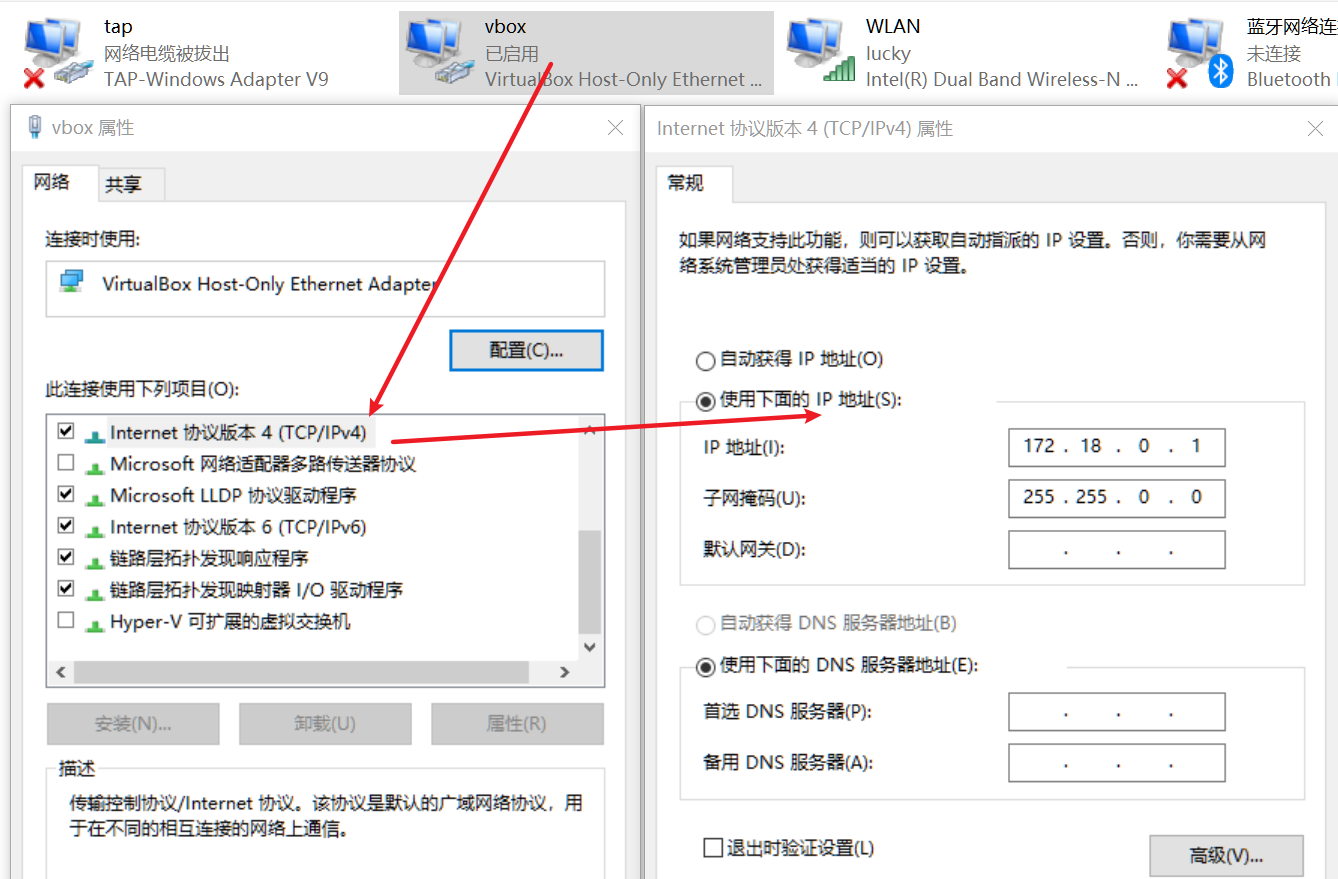
-
NetAppT - the SAME SOME/IP configuration but built on the OSAL host sockets (SoAd_T / SomeIp_T / Sd_T test variants), i.e. the protocol stack runs natively on the PC without LWIP:
scons --app=NetAppT --os=OSAL
build\nt\GCC\NetAppT\NetAppT.exe
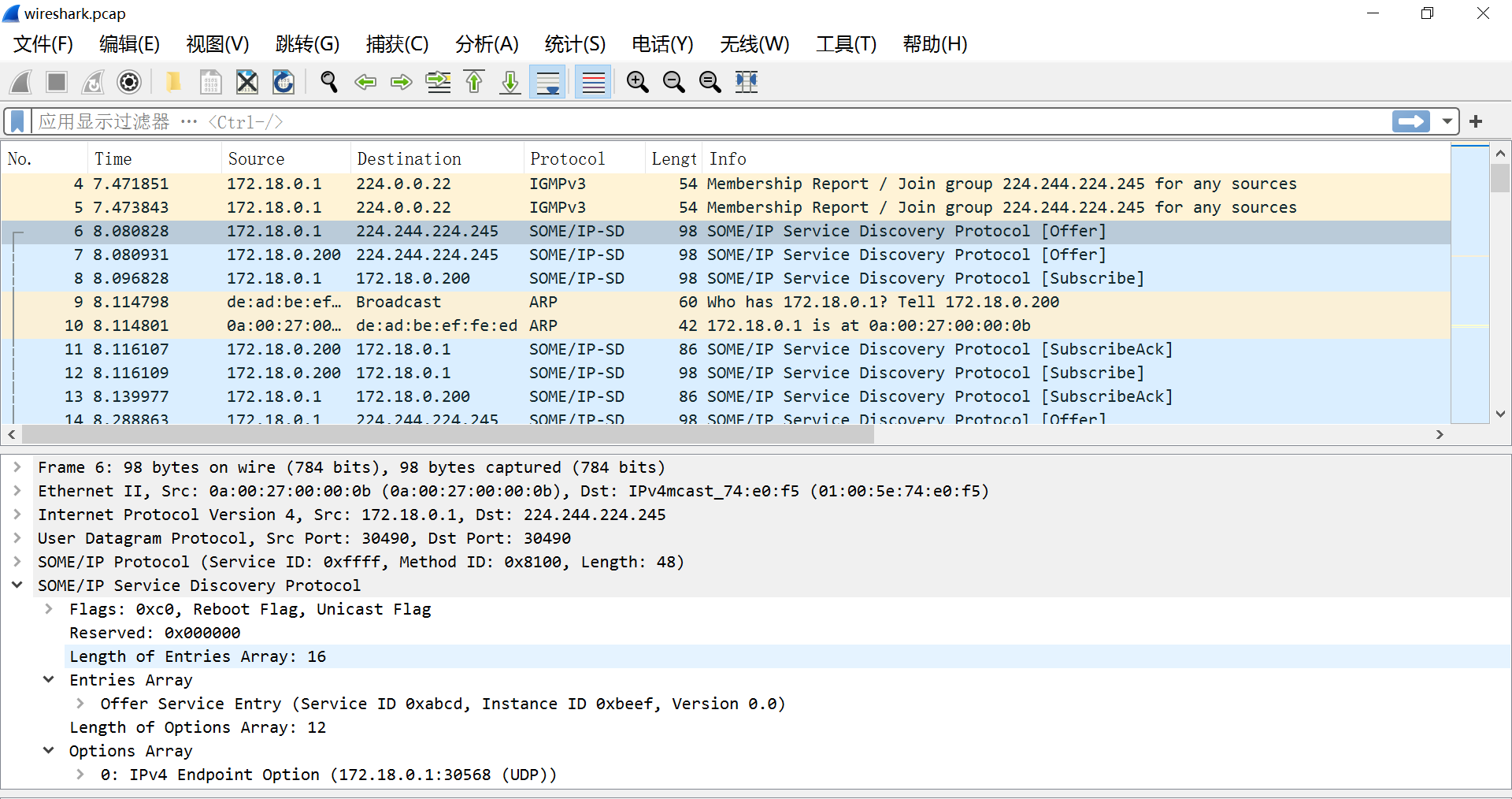
Run NetApp and NetAppT in two terminals and they discover each other over SD and exchange method/event data. The offered services come online through the generated ServiceX_OfferService() calls in the application skeleton code. With USE_PCAP=YES, a text trace net.log and a capture file wireshark.pcap are written to the working directory:
6. Interoperability with vsomeip
To prove wire-level compatibility, the ARA-style RadarService example can be compiled with the open-source vsomeip backend instead of the AS stack, and the two backends interoperate. The build scripts fetch a maintained mirror automatically (infras/libraries/dds/vsomeip/SConscript):
# build the vsomeip shared libraries (downloaded from gitee.com/autoas/vsomeip)
scons --lib=vsomeip3 -j8
scons --lib=vsomeip3-cfg --prebuilt -j8
scons --lib=vsomeip3-sd --prebuilt -j8
scons --lib=vsomeip3-e2e --prebuilt -j8
scons --app=vsomeip3-routingmanagerd --prebuilt -j8
Then build one side with the vsomeip backend and the other side with the AS backend (selected by the SOMEIP_BACKEND environment variable in the RadarService SConscripts):
# client uses vsomeip
set SOMEIP_BACKEND=vsomeip
scons --app=RadarServiceClient --os=OSAL --gen

# server uses the native AS SOME/IP stack
set SOMEIP_BACKEND=someip
scons --app=RadarServiceServer --os=OSAL --gen
Run the routing manager first (vsomeip requires a routing manager on each machine), then the server and client. The vsomeip client discovers the AS server through SD and communicates with it exactly as with another vsomeip node.
7. Troubleshooting
- LWIP/PCAP cannot open an adapter - check that
PACKET_LIB_ADAPTER_NRmatches the VirtualBox adapter index printed byipconfig; assign it172.18.0.1; allow the traffic through the Windows firewall. - OSAL examples see no traffic - the OSAL port uses the host socket stack; make sure UDP multicast
224.244.224.245is not blocked by a VPN or firewall, and capture on the correct (loopback / multicast) adapter in Wireshark. - Services never find each other - verify both sides use the same multicast group and Service/Instance IDs; SD entries carry TTLs, so a stopped side disappears after the TTL expires.
- vsomeip client does not connect - the routing manager must be running, and its JSON configuration must match the network interfaces; start it before the client/server applications.
- TP messages time out - remember
SomeIp_MainFunction(andSd_MainFunction) must be scheduled cyclically; segmented transfers and the SD timers are driven from these main functions.